[1] THE BRIEF
RichAPI is a B2B data API and MCP server: one key, one credit pool, and contact, company, social and signal data from more than forty licensed providers. The site it came to us with was well made and said the wrong thing. It sold RichAPI as a fresher database — “verified B2B data, fetched the moment you ask” — when what RichAPI does is route each lookup to providers people already know. The story had to be fixed before the page could be.
- Client
- RichAPI, a TexAu product
- Product
- B2B data API and MCP server
- Scope
- Positioning, website design
- Year
- 2026
[2] WHERE IT STARTED
ONE CLAIM,
THE WHOLE PAGE
Long, earnest, and built on a single word: live. Every section after the hero tried to prove it — the data you bought is already wrong, pulled live the second you ask, fresh is only worth it if it’s accurate. Read top to bottom, it describes a company that owns a database and keeps it fresher than its rivals do. RichAPI owns no database.

[3] READING IT AS A BUYER
WHAT IT SAID,
WHAT IT MEANT
The page read as a data buyer would. Almost every question led back to one missing line: where the data comes from.
- 01
“Verified B2B data, fetched the moment you ask”
Fetched from where? It never says the data isn’t RichAPI’s own.
- 02
“The data you bought is already wrong”
Reads as a claim to a better database. RichAPI doesn’t have one.
- 03
“Pulled live, the second you ask”
No how. It’s live because the providers are — and it’s a side point.
- 04
“Charged for misses: never”
What counts as a miss, and who decides?
- 05
“Built for the people who run outbound”
No word of providers, so buyers assume every record is verified.
- 06
“Call it from anywhere”
The real answer, buried two-thirds down as a feature grid.
- 07
Frequently asked questions
Still doesn’t explain “live” or “verified”.
[4] THE REFRAME
NOT A BETTER
DATABASE. A ROUTE
TO THE ONES YOU TRUST
Before
RichAPI has fresher data than the database you bought.
A claim nobody can check, against competitors the buyer may be happy with — and not what the product does.
After
RichAPI reaches the providers you already know, through one key, at one price.
True, checkable, and it borrows the trust those names have already earned. “Live” falls out of it for free: the providers keep their data current, RichAPI asks them the moment you call.
Putting Apollo or People Data Labs on your own homepage looks, at first, like advertising someone else. Here it does the opposite: for anyone who has used either, one row of logos is association and social proof at once.
[5] FOUR WAYS TO SAY IT
The same headline and the same copy, four ways. Each had to put the new idea — many providers, one route — on the first screen without a paragraph to explain it.
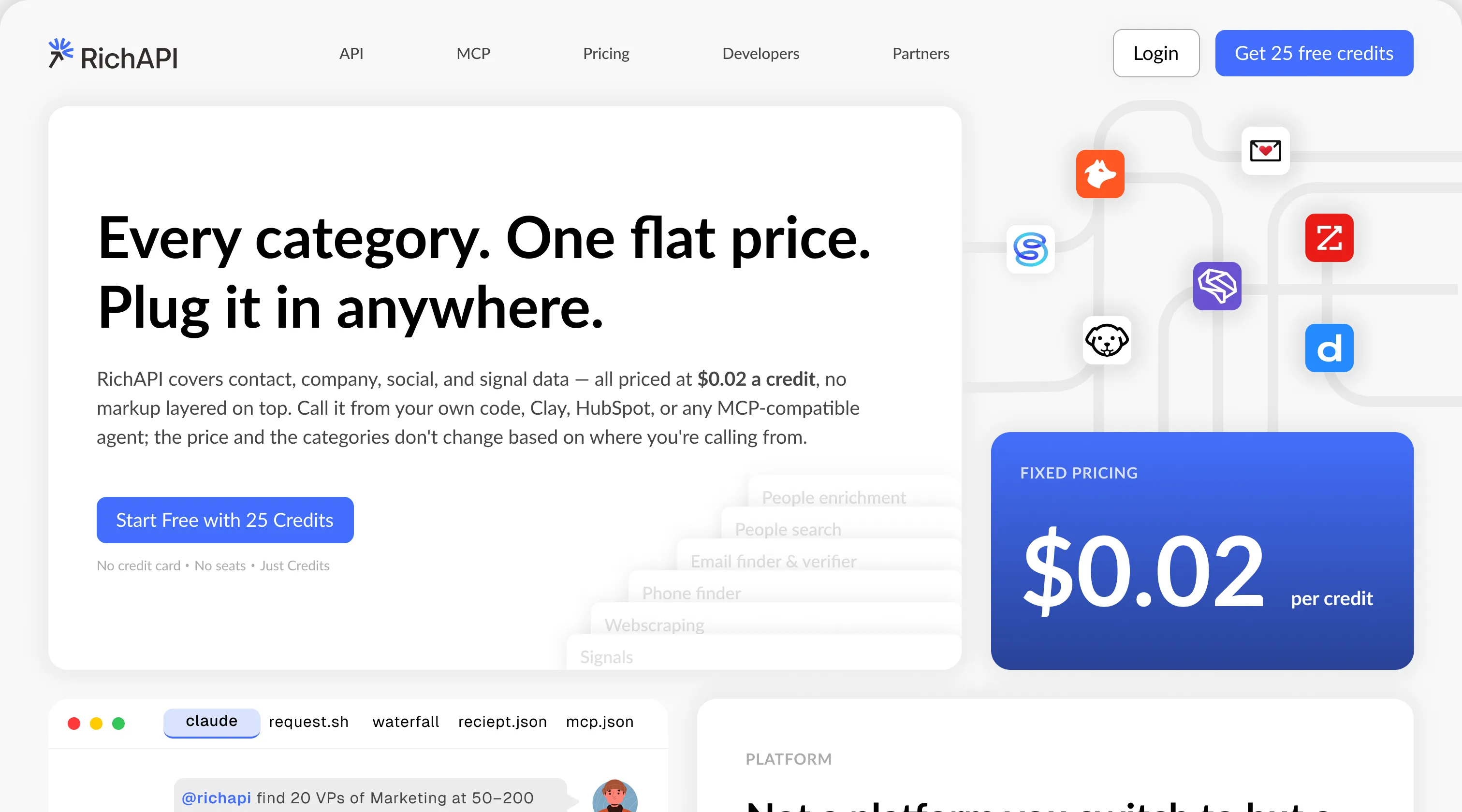
A — Friendly, product-led
Soft white cards, rounded corners, one confident blue. Provider logos ride transit lines into a price card. Approachable and clear about money, but it read as a pricing page before it read as a product.
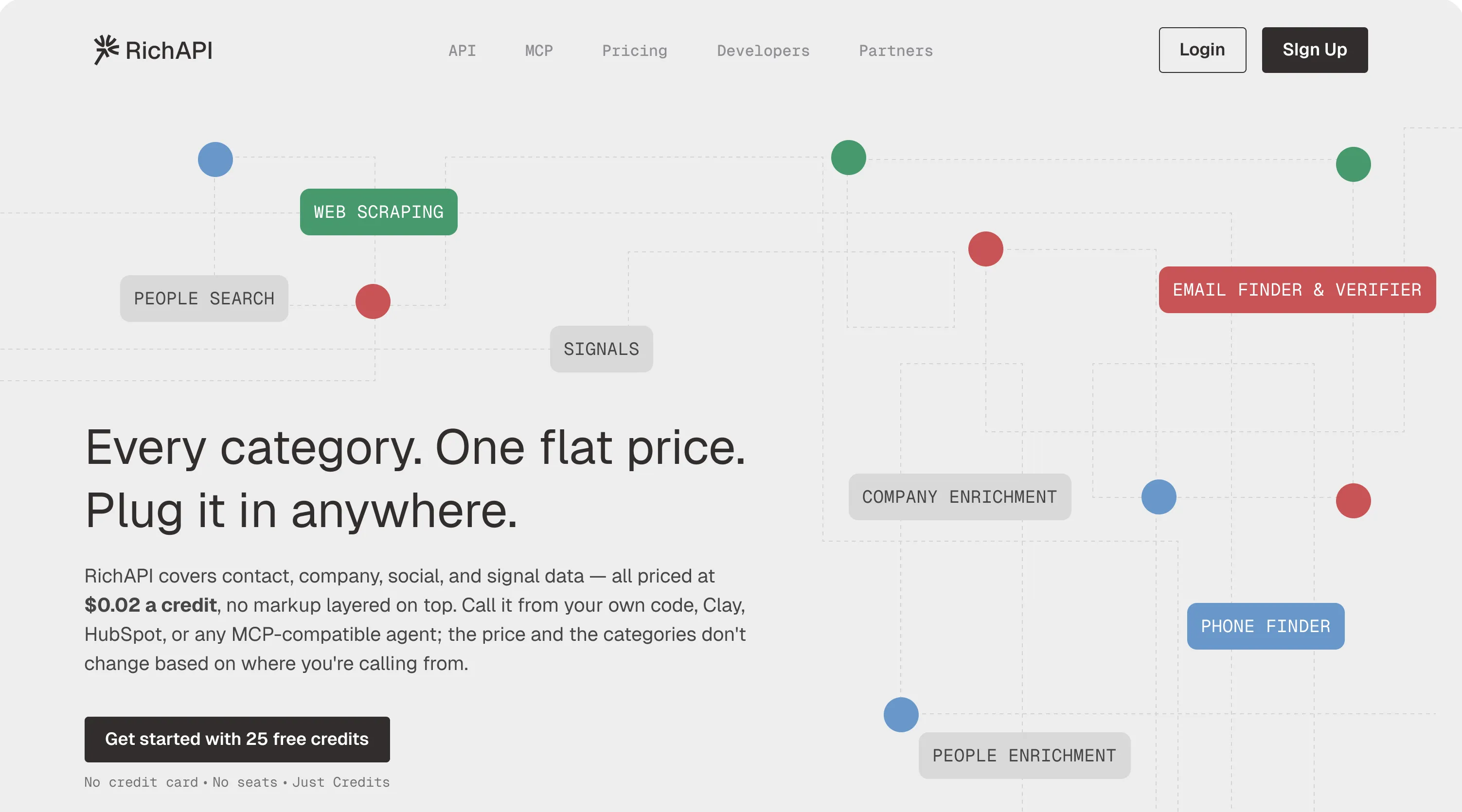
B — Technical, playful
Monospace tags and bright dots on a dashed wiring diagram — a developer’s sketchbook. It showed routing with some wit, and lost the providers, the one thing the story now depended on.
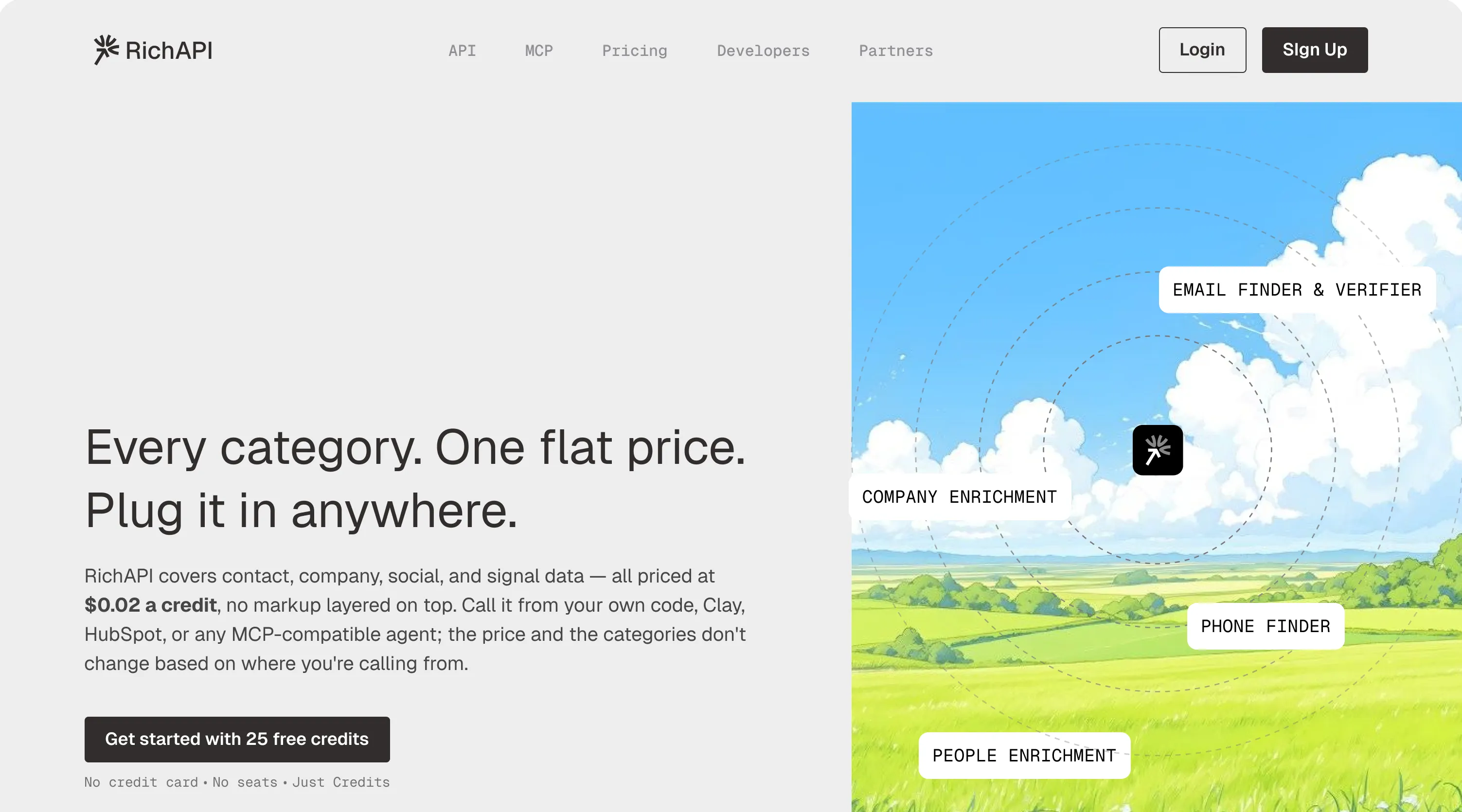
C — Dreamy, calm
An illustrated sky and open field, the mark at the centre of rings with the categories in orbit. The warmest and most human of the four — and the landscape said nothing at all about data.
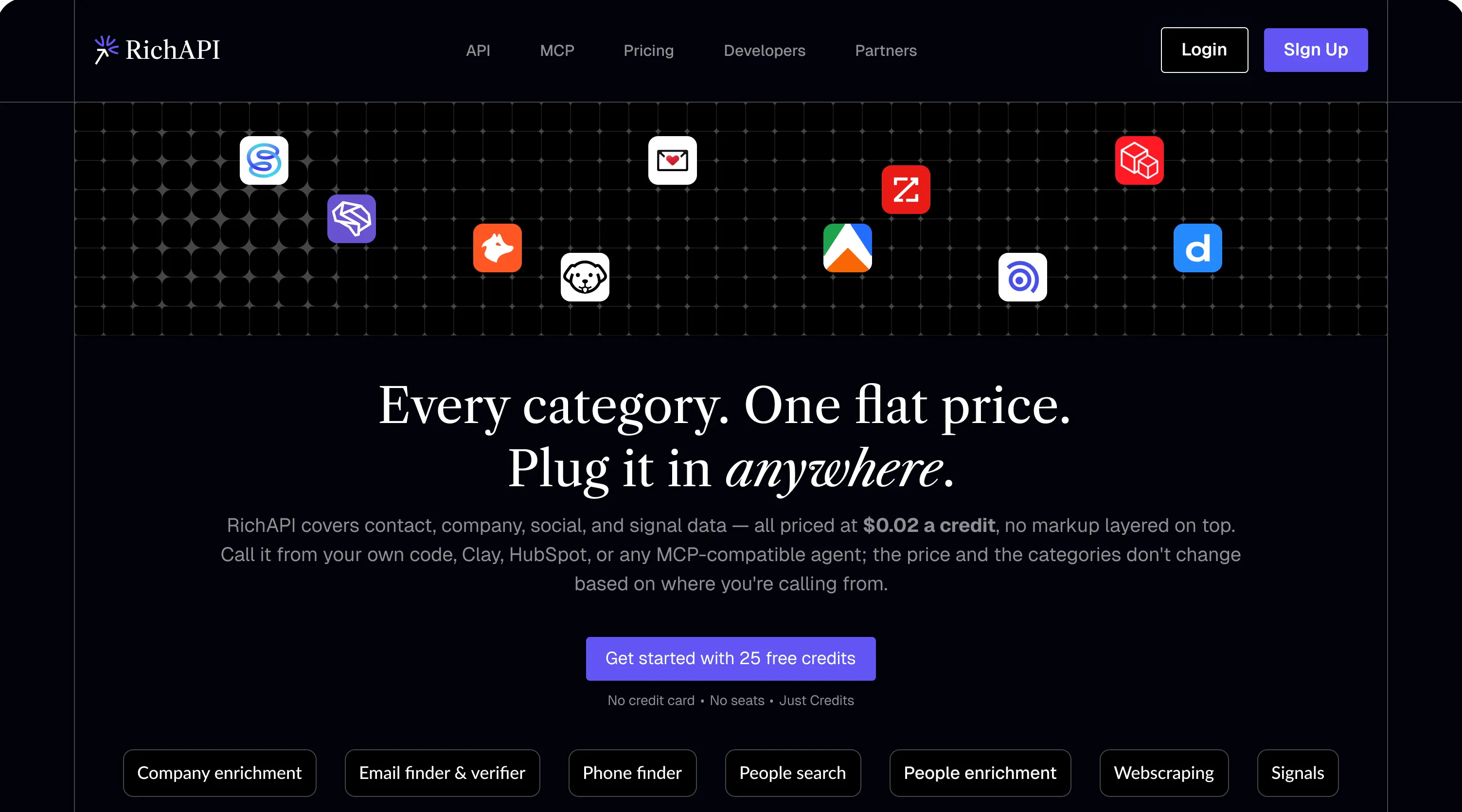
D — Premium, editorial Taken forward
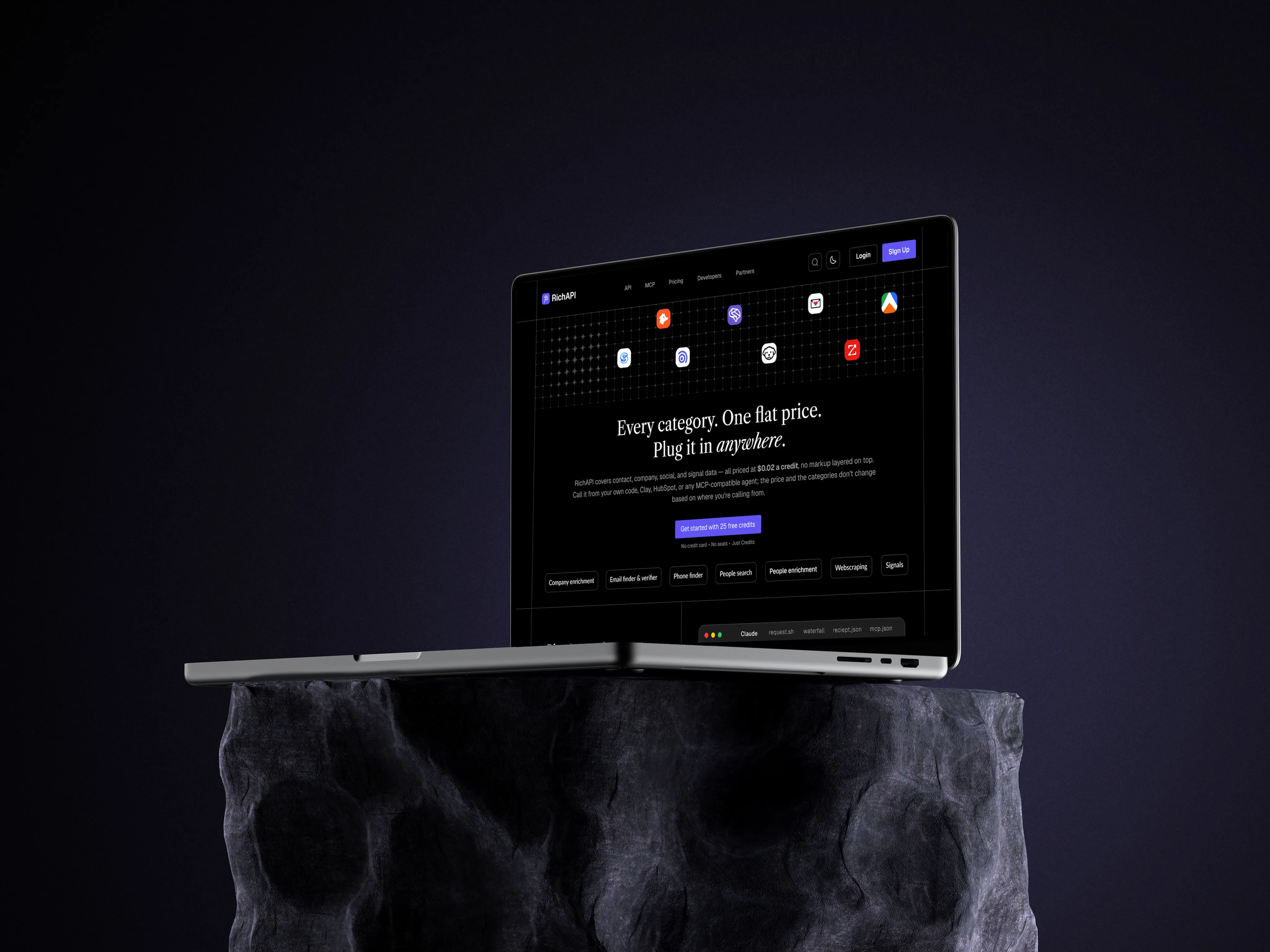
Near-black, a fine grid, a serif headline with an italic turn. Serious enough for a data buyer, and the providers sit right at the top — the first thing you see is who RichAPI talks to.
[6] WHAT SHIPPED
EVERY QUESTION,
ANSWERED ON THE PAGE
The live site, running below. Each question from the audit has an answer somewhere on it.
- Who answers
- The providers sit above the headline, with one line under them: RichAPI routes each lookup across these and others, 40+ in total. Familiar names do the trust-building — someone who has used Apollo already half-trusts the product sitting on top of it.
- Live, explained
- Live contact, company, social and signal data from licensed providers. “Live” stopped being a claim about RichAPI’s database and became a description of how a lookup works.
- Misses, defined
- Email and phone lookups that find nothing cost nothing. A result counts as verified only when the waterfall returns a positive deliverability or reachable signal.
- A receipt
- Every waterfall call returns an execution log: which providers were tried, which one answered, what was billed. The hidden cost the old page complained about, shown instead.
- The markup, asked out loud
- “Do you mark up the underlying providers? Partly, yes.” The objection the old page stepped around is the first question in the FAQ, answered plainly.
- Usage up front
- REST, MCP, Clay, HubSpot, Claude — the second section, with the call itself on screen, rather than a grid two-thirds of the way down.